Welcome to stewartchronicles.com
Welcome to stewartschronicles.com I’m excited to have you here as I begin a trek through Scotland’s stone, steel, and stories in the 15th and 16th centuries. This site expands on my previous blog, “In the Footsteps of James IV,” and broadens the focus to Scotland’s wider historical landscape in this period. It also lets me zoom out from James IV to broader historical perspectives.
The fifteenth and sixteenth centuries forged the Scottish nation. From James I’s return in 1424 to Mary, Queen of Scots’s abdication in 1567, this era was dramatic. We are talking about child monarchs, rebellious nobles, and the cultural earthquakes of the Renaissance and the Reformation. This period was immensely volatile and left a striking physical footprint, and this site will trace how that footprint remains visible in Scotland today.
This blog explores that legacy, one historic site at a time.
Every month, I step out of the dusty archives and hit the ground running. I’ll visit places of interest, from royal palaces and ruined castles to atmospheric battlefields. When we get there, we will use those sites to examine how Scotland’s 15th and 16th centuries shaped place, memory, and historical understanding through two distinct lenses:
- The Architecture: We’ll examine the physical structures and how they changed over time. Through restorations, additions, and battles, we’ll uncover how people used and defended these spaces, how they flourished, and how they fell into decay.
- The Human Stories: We’ll shine a spotlight on the real people. I want to explore the lives, motives, and fates of the key historical figures who walked these halls, defended these walls, or fought on these fields.
To get the real, unvarnished truth, we’ll ground the narrative in primary sources. We’ll draw on the writings of early Scottish authors, including Hector Boece, John Mair, Robert Lindsay of Pitscottie, Bishop John Lesley, and George Buchanan. We’ll also consult ‘The Days of James IV’, the Treasurer’s Accounts, the Compota Thesaurariorum Regum Scotorum, and Piccolomini’s vivid ‘Commentaries’, bringing the story to life with verbatim quotes from those who lived it.
I look forward to your regular check-ins; please leave comments and suggestions.
St Giles Cathedral. October 2026
The Stewart Monarchs’ association with St Giles Cathedral
List of Stewart Monarchs
The fourteen reigning Stewart monarchs
Robert II (1371–1390); Robert III (1390–1406); James I (1406–1437); James II (1437–1460); James III (1460–1488); James IV (1488–1513); James V (1513–1542); Mary, Queen of Scots (1542–1567); James VI & I (1567–1625); Charles I (1625–1649): Charles II (1660–1685).
The association each had with St Giles
- King Robert II (1371–1390) is associated with St Giles’ Cathedral mainly through war-planning meetings, the English retaliatory burning, and the church’s rebuilding. Scottish knights and barons met secretly with French envoys inside St Giles’ where they arranged a joint raid into the northern counties of England. The raid proved militarily successful, but it provoked a vicious response. Richard II of England marched north, laid waste to the Scottish borders, and set Edinburgh on fire. In 1387, the Provost and community of Edinburgh signed an indenture with master masons to build five new chapels along the church’s south side, altering the church from its older 12th-century Romanesque design toward a Gothic structure.
- Robert III (1390–1406). In 1393, he formally granted Scone Abbey the revenues and control of St Giles’ Kirk in Edinburgh. This was a debt settlement, not an act of religious devotion. After becoming king in 1390, Robert III owed Scone Abbey a substantial sum for his lavish coronation and his father King Robert II’s funeral. He repaid the debt by transferring the lucrative rights and income of Edinburgh’s principal parish church.
- James I (1406–1437): Unlike his father, Robert III, who used St Giles’s revenues to pay royal debts, James had little involvement with Edinburgh’s principal parish church. Instead, he focused his religious patronage on founding the Carthusian Charterhouse in Perth. On 20 February 1437, disaffected nobles led by Sir Robert Graham brutally murdered James. After his assassination at the Blackfriars monastery in Perth, he was buried beside his queen, Joan Beaufort, in the charterhouse church. Shortly after his death, an official Requiem Mass was held for James I at St Giles’ Cathedral.
- James II (1437–1460). The historical connection between King James II of Scotland and St Giles’ Cathedral (then the High Kirk of Edinburgh) focused on architectural development, royal patronage, and the Scottish monarchy’s concentration on Edinburgh. Around the time of James II’s death in 1460, work began to expand the chancel, the area around the altar, and add a clerestory to St Giles’. His widow, Mary of Guelders, supported and funded this major building project as a monument to her late husband. Construction of Edinburgh’s iconic crown spire began during this period, using heavy oak beams felled between 1453 and 1460. His reign laid the groundwork for St Giles’ elevation to the prestigious status of a collegiate church. Although Pope Paul II granted the official papal bull in 1466, shortly after James II’s death, the expansion of chaplainries, royal endowments, and civic importance during his lifetime helped the church grow to hold as many as fifty altars by the time of the Reformation.
- James III (1460–1488). The historical connection between King James III of Scotland (1460–1488) and St Giles’ Cathedral marks an era when the church reached new heights of institutional independence, became a symbolic anchor for the Scottish “Imperial Crown”, and served as the spiritual backdrop for a permanently established capital city. James III further boosted its administrative prestige; in 1470, he successfully petitioned Pope Paul II to issue a papal bull granting St Giles complete exemption from the Bishop of St Andrews’ jurisdiction.
- ❖ King James IV (1488–1513): He had a profound structural, political, and emotional connection to St Giles’ Cathedral, historically known as the High Kirk of Edinburgh. He made the church central to governing his capital. During his reign, work on St Giles’ medieval crown spire was completed. Finished around 1495, its distinctive eight-buttress crown steeple stood as a testament to the Stewart monarchy’s prestige and the medieval city’s wealth. This connection became most poignant after the catastrophic Battle of Flodden in September 1513. After James was killed while invading England under the Auld Alliance, along with many of Scotland’s leading nobles, panic swept the capital. In the aftermath, Edinburgh’s provost, Gavin Douglas, ordered the city’s women to gather inside St Giles’ and pray for their fallen king’s soul and the safety of the realm. The lavish expansions and altars that had flourished during James IV’s prosperous golden age then came to an abrupt halt.
- James V (1513–1542) inherited the crown as an infant. His subsequent reign marked a volatile chapter for St Giles’ Cathedral, defined by fierce defences of the Catholic faith, major updates to the crown jewels used within its walls, and the complex choices of his royal descendants.
- Mary, Queen of Scots (1542–1567) Unlike her predecessors, she had a politically fraught relationship with St Giles’. When she returned from Catholic France in 1561 to rule a Scotland that had recently made the Protestant Reformation law, St Giles’ became a centre of religious and cultural opposition to her crown. The Protestant reformer John Knox became the cathedral’s official minister, condemning Mary’s Roman Catholic faith and her private celebration of Latin Mass at Holyrood Palace. St Giles’ stood at the heart of the ideological standoff. Mary avoided Protestant services at the church, but did attend St Giles’ for secular and state events, including the formal openings of the Scottish Parliament in the 1560s.
- King James VI (1567–1625) James brought a highly personal, intellectually combative, and transformative dynamic to St Giles’ Cathedral. Rather than treating St Giles’ merely as a backdrop for statecraft, he made it a personal arena for theological debate and for staging the momentous Union of the Crowns. A notably intellectual king, he took immense pride in his theological scholarship, which later culminated in his authorisation of the King James Version of the Bible. When attending services at St Giles’, he was far from a passive listener: he regularly interrupted ministers mid-sermon, loudly arguing points of scripture, state policy, or doctrine from his royal seat. His close management of the kirk is documented in surviving correspondence at the National Library of Scotland. In detailed, direct letters to Patrick Galloway, Moderator of the General Assembly and minister of St Giles’, James sought to steer church governance. James’s belief in the “Divine Right of Kings” collided with the Presbyterian belief that Christ alone ruled the church inside St Giles’ on 17 December 1596. Sitting in the Tolbooth section of the kirk with his financial advisors, James heard Walter Balcanqual, a popular preacher, deliver a fiery sermon accusing the crown of endangering the Protestant faith. The sermon sparked a chaotic riot, forcing the terrified King to flee the building and temporarily move the royal court to Linlithgow. After punishing the city, James returned in triumph and consolidated his control over the building. This crisis tightened royal control, and state records first formally referred to the entire complex as the “High Kirk”. When Queen Elizabeth I died in 1603, James inherited the English throne, uniting the crowns of Scotland and England. Before leaving for London, he chose St Giles’ as the setting for his official farewell to the Scottish people. On 3 April 1603, he joined the large congregation to hear a sermon, then stood and delivered a deeply emotional speech to the weeping crowd. He promised his heart would remain in Scotland and swore he would return every three years. James returned to Scotland once, in 1617, when he tried to impose Anglican-style practices on the Presbyterian St Giles’ by restoring bishops and introducing the English Book of Common Prayer into services. James initially suppressed the Scottish reformers’ vehemence, but his ecclesiastical policies undoubtedly laid the groundwork for the riots, the National Covenant, and the civil wars that engulfed St Giles’ under his son, Charles I.
- King Charles I (1625–1649) had a contentious association with St Giles’ Cathedral, culminating in the Jenny Geddes riot that helped spark the Wars of the Three Kingdoms. Charles lacked his father James VI’s political tact on Scottish Presbyterianism and sought to impose uniform High Anglican practices and a new liturgy on Scotland. The flashpoint came on Sunday, 23 July 1637, with the first public reading of Charles I’s new Book of Common Prayer at St Giles’. Compiled with Archbishop William Laud, the English-style liturgy was seen by Scots as a veiled attempt to reintroduce “Popery” and weaken the independence of the Church of Scotland. Jenny Geddes stood up in protest and hurled her wooden folding stool at his head, shouting, “Daur ye say Mass in my lug?” (“Dare you say Mass in my ear?”). Her act helped ignite a riot inside the cathedral, with congregants throwing Bibles and furniture before the protest erupted into the streets of Edinburgh and across the nation. The outrage over Charles’s actions led an estimated 300,000 Scots to sign the National Covenant at nearby Greyfriars Kirkyard in 1638, swearing to protect the church’s spiritual freedom from royal usurpation. A framed copy of this document hangs inside St Giles’ today.
- King Charles II (1660–1685) After Oliver Cromwell’s death, King Charles II (1660–1685) ushered in the Restoration, a bloody and deeply divisive chapter for St Giles’ Cathedral. In 1661, Charles II officially re-established Episcopacy (rule by bishops) across Scotland. With this decree, St Giles’ was formally elevated to full Cathedral status once again. His reign saw the church swing violently back from rigid Puritanism to royal Episcopacy, turning parts of the building into a prison for religious dissidents and giving rise to the city’s oldest monument. Ministers who fiercely refused to align with the King’s new episcopal system were systematically ousted from their pulpits. Charles II’s religious policies sparked widespread, armed defiance from the Presbyterian Covenanters. Following the suppression of the Covenanter uprisings, most notably the Battle of Rullion Green in 1666, St Giles’ took on a dark, domestic role in state security. Dozens of captured Covenanters were crammed inside this cold, stone wing of the church. They were held there under heavy guard before being marched out to the Grassmarket to face public execution, exile, or forced deportation.
Addenda
The founding of St Giles: David I established a parish church on Edinburgh’s eastern edge. He granted the church and its revenues to the Order of Saint Lazarus of Jerusalem to care for lepers. He introduced sweeping European-style reforms that transformed Scottish society. He was not a Stewart but a member of the House of Dunkeld. In the 14th century, fire devastated St Giles’ Cathedral twice, both times during English invasions in the Wars of Scottish Independence. After the Scottish victory at the Battle of Bannockburn (1314) and the subsequent declaration of Scottish independence, Edward II invaded Scotland; as his army retreated, it advanced into Edinburgh and set fire to the 12th-century Romanesque church, causing severe structural damage. Bruce was not of the House of Stewart. He and his son, David II, were the only two kings of the House of Bruce. His daughter, Marjory Bruce, married Walter Stewart, the 6th High Steward of Scotland. When his son David II died childless in 1371, the crown passed through Marjory’s line to her son Robert II, who became the first monarch of the House of Stewart. The second fire, in August 1385, occurred while Robert II, a Stewart monarch, was king.
A collegiate church is a Christian church where a college of canons—a self-governing community of ordained, non-monastic clergy conducts daily religious services. It is not a cathedral and has no bishop or diocesan responsibilities. In the medieval period, wealthy patrons and noble families endowed local chapels to support priests whose primary duty was to pray for founders’ souls. Collegiate status replaced a single priest with a college of canons, a provost, prebendaries, a sacristan, and a choir. Edinburgh’s town authorities campaigned for decades to secure collegiate status for St Giles’, knowing it would enhance the city’s civic prestige, financial autonomy, and religious capacity as it grew into Scotland’s capital. Before 1466, St Giles’ was subject to monastic orders that regulated its growth and appropriated its revenue. Although monarchs, local lords or landowners, and merchant guilds could not unilaterally declare a church collegiate, they often drove such petitions. Collegiate status let the nonreligious town council and local private investors control funding, ensuring money raised in Edinburgh stayed to expand the church. As Edinburgh consolidated its position as Scotland’s political and economic heart, its leaders believed its central church should reflect that dominance: collegiate status was the highest and most prestigious ecclesiastical rank a town church could attain. Securing the Pope’s approval took three official petitions to Rome over nearly five decades. 1419: Archibald Douglas, 4th Earl of Douglas, formally petitioned Pope Martin V. That year, the choir of St Giles’ was completed. With the building restored, the town authorities felt it was time to elevate its institutional standing. Rome denied the request. 1423: A petition drafted by Edinburgh’s town authorities and church officials, including Edward Lauder, was delivered to Rome. It failed again, as monastic orders fought to protect their financial claims and rights over Edinburgh’s primary parish church. 1466: Forty-seven years after the first attempt, the burgh launched its final petition. Backed by King James III, its representatives argued that Edinburgh was now “amongst the most populous, famous and splendid” towns in Scotland and deserved elevated status for its church. Pope Paul II granted collegiate status in February 1467. Forbes and James III both helped the petition succeed. Forbes claimed royal lineage and was the nephew of the late, highly influential Bishop James Kennedy of St Andrews. He negotiated to become the first Provost (head) of St Giles’. By the late 1460s, Edinburgh had changed fundamentally from the town that petitioned in 1419; it was now the seat of the Scottish Parliament, the royal court, and the national mint. He argued that it embarrassed Scotland and the Catholic world that the church had not been granted collegiate status. To fund the new college, Forbes offered to resign his lucrative rectory at Dunbarney and legally annex its wealthy parish lands and tithes directly to St Giles’. This injection of agricultural wealth immediately met Rome’s strict requirement that the church could “suitably sustain” its new staff. With pressure from the King, the financial security provided by Forbes’s annexation, and Edinburgh’s prestige all in its favour, Pope Paul II issued the final papal bull in February 1467 (recorded historically as 1466 under the old calendar style), officially transforming St Giles’ into a self-governing collegiate powerhouse. James III’s royal endorsement was a major factor in the petition’s success. He signed a charter formally supporting the elevation. His support changed the circumstances: a sovereign king was now presenting a diplomatic demand to Pope Paul II, rather than a wealthy trading burgh seeking a favour. Collegiate status gave the Town Council and wealthy merchant guilds a direct role in governance, effectively making St Giles’ the civic centrepiece of Edinburgh. This boosted the city’s political autonomy, administrative influence, and cultural prestige. As the city expanded under its new status, local trade and merchant guilds established their own chapels and altars in the building. These guilds functioned as benevolent secular societies, using their dedicated spaces to support members’ welfare, manage trade agreements, and arrange dignified burials. The collegiate structure allowed St Giles’ to partner directly with private investors, local merchants, and wealthy burgesses. This influx of capital funded extensive building expansions, creating jobs for local stonemasons, craftspeople, and labourers while stimulating Edinburgh’s urban economy.
A visual tour of St Giles High Kirk known as St Giles Cathedral
St Giles’ Cathedral sits on the south side of the High Street section of the Royal Mile, approximately 500 metres (0.3 miles) from the Castle. It is built on a standard east-west Christian layout, positioned parallel to the street so that its long north exterior walls face directly onto the Royal Mile.
.
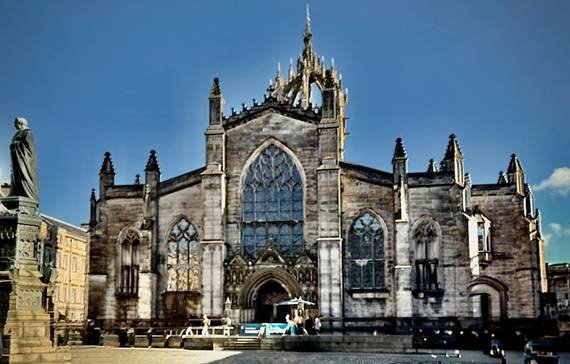
West Side of St Giles High Kirk, known as St Giles Cathedral
Photograph by A Santini © 2026
The west side of St Giles’ Cathedral features the Great Western Door, the only current visitor entrance. It is flanked by Gothic stone niches and faces directly up the Royal Mile towards Edinburgh Castle. It was designed by architect William Hay during the church’s 19th-century Victorian restoration. Above the lintel, a carved tympanum by John Rhind depicts Saint Giles, flanked by stone niches holding small statues of Scottish monarchs and churchmen.
From the west door, the view stretches down the central nave, past the 14th-century arcade pillars, toward the central crossing, the marble communion table.
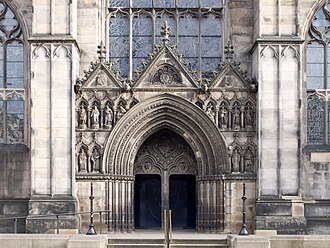
The Victorian West Doorway, designed by William Hay with statues carved by John Rhind. Public Domain.
.
The view of the West Wall stained-glass window from the central aisle. Photograph by A Santini © 2026
Installed in 1985 directly above the great western entrance, the Robert Burns Memorial Window is a large modern work by Icelandic artist Leifur Breiðfjörð. The blue painted ceiling roofs the nave. . In the 1450s, the west wall was shorter than it is today, with the roofline roughly 16 feet (5 metres) lower than present, giving the western facade a much squatter and less soaring appearance.
Moving anti-clockwise around the building to the South Wall.
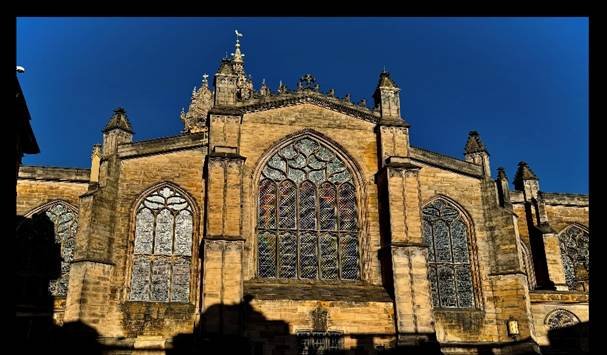
The South Wall. Photograph by A Santini © 2026.
In the 1450s the exterior consisted of coarse medieval rubble walls rather than polished stone. Later, a haphazard collection of permanent wooden and stone lean-tos, shops, and market stalls known as the Krames obscured the wall. These structures remained crammed up against the church walls for centuries until they were finally cleared away during the major structural restorations of the early 19th century.
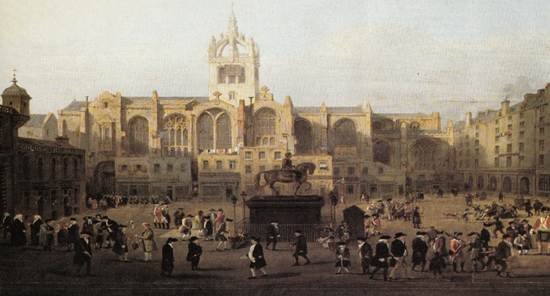
The south side of St Giles’ prior to the Burn restoration. Public Domain.
Moving onto the East Wall.
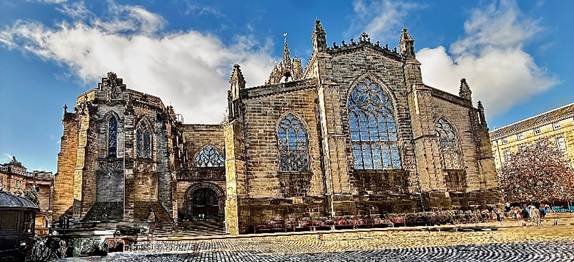
East wall of St Giles. Photograph: A Santini © 2026
The Thistle Chapel is visible from the outside, standing out as an ornate projection at the church’s southeast corner, exactly where the East Wall meets Parliament Square. The East Wall terminated the choir (or chancel). In the 1450s, the wall was coarse medieval rubble stone, dominated by a large pointed Gothic window that lit the high altar. The medieval stained glass of the 1450s would have featured Catholic iconography and heraldry, both of which were destroyed during the frenzied iconoclasm of the Scottish Reformation in 1559.
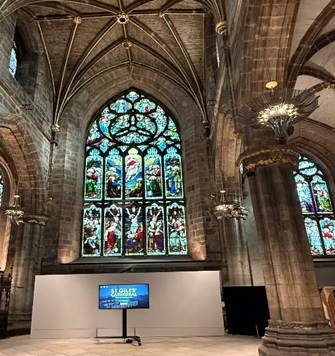
The Great East Window at the East End of the Choir was placed and completed in 1877. It sits above where the high Roman Catholic altar once stood. Photograph by A Santini © 2026
The North Wall of the Church:
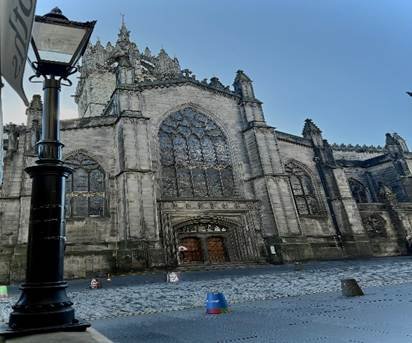
The North Wall of the Church. Photograph A. Santini © 2026
The church’s north side once faced a narrow lane known as the Stinkand Style. Opposite the north face of St Giles’ stood the Luckenbooths, a congested block of multi-storey tenements with lockable shops on the ground floor. They stood for nearly 400 years, from around 1440 until their demolition in 1817, forming a cramped, bustling medieval shopping district that served as the commercial heart of old Edinburgh. The original 12th-century Romanesque doorway on the north wall no longer exists; it was destroyed at the end of the 18th century. The entryway seen today, though not in public use, is actually a late-Victorian restoration.
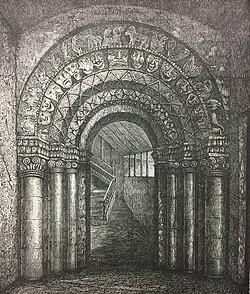
The Romanesque doorway was destroyed towards the end of the eighteenth century. A woodcut engraving of the destroyed 12th-century north door of St Giles’ Cathedral, Edinburgh, from ‘Cassell’s Old and New Edinburgh’ (1881), volume I, p. 141.
Additional views
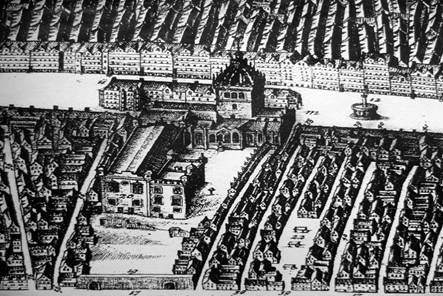
St Giles’ in 1647, showing the Tolbooth and the Luckenbooths to the north of the church and Parliament House in the kirkyard to its south. Beyond St. Giles is a row of open-fronted shops called the Luckenbooths. The town’s Tolbooth occupied the left end of the row. St. Giles Kirk and Parliament House from James Gordon of Rothiemay’s map of Edinburgh, 1647. Public Domain File:
Dear Readers,
Thank you for reading this blog. It is entirely non-profit and completely ad-free. I run it solely out of a passion for Scottish history and heritage. If you have been inspired by St Giles, from its ancient Romanesque beginnings to the bustling stories of the Luckenbooths, remember that maintaining and conserving these heritage centres is expensive. They require constant care and specialist restoration to survive for future generations. Please consider making a financial contribution to help maintain these magnificent buildings. However, if you choose to donate, please send your support DIRECTLY to the official heritage site or church. I do not accept any donations or payments on behalf of the site. Thank you once again for your readership, your passion for history, and your generosity in keeping our shared heritage alive.
Professor Ario Santini FSA Scot
No Coffee for Mary: My Autumn Day Out, Tracking Edinburgh’s Stewart Royalty
Welcome to my first blog post! I’m absolutely thrilled you’re here. If you’re the sort of person who, upon seeing an old stone building, immediately wonders what dramas unfolded inside centuries ago, you’re in the right place. Today, we’re heading into the heart of Edinburgh to visit the magnificent St Giles’ Cathedral and trace all fourteen Scottish Stewart monarchs within one building.
On a crisp October morning, I arrived at West Parliament Square, determined to photograph the cathedral from all four sides.
To get the perfect angle of the North Door, I crossed the road and climbed onto a low wall outside a restaurant called the “Luckenbooths”—the only business on the Royal Mile (High Street) to retain the name of the fifteenth-century tenements that once stood in front of the church’s north wall. Later, just outside the “Angels with Bagpipes”, I climbed another small wall, which gave me a nearly unobstructed view of the stunning architecture before I headed inside.
But as I headed back down toward the entrance, reality hit. A sizeable queue snaked its way to the door, and panic set in when the smiling official told me I should have pre-booked my slot online! Just as I thought my grand history expedition had been thwarted before it even began, a lovely young woman working at the door came to my rescue. She told me not to worry, patiently guided me through logging in on my phone, and within 25 minutes, we had my entrance ticket sorted. With my phone, notes, and camera full of fresh exterior shots, I finally stepped inside to take photographs and notes.
Retracing the Steps of 14 Monarchs
Walking the aisles, you can practically feel the ghosts of the Stuart line. This single church served as the backdrop for all fourteen of Scotland’s Stuart monarchs, from the beginning of the dynasty to the end:
The Early Kings (Robert II to James V): These monarchs helped shape the physical church, expanding the altars, funding the building work, and navigating the turbulent medieval years. Mary, Queen of Scots: Standing near the centre of the church, I pictured Mary attending tense civic events here in the 1560s, keeping her royal composure. At the same time, the fiery Protestant reformer John Knox preached blistering sermons from the pulpit. King James VI: This is where James VI famously preached his farewell sermon to the people of Edinburgh in 1603 before heading south to claim the English crown. Charles I: Walk over to where the altar used to be, and you’re standing near the spot where Charles I tried to force an English-style prayer book on the congregation in 1637. A local woman named Jenny Geddes was so furious that she famously threw her wooden stool straight at the bishop’s head, sparking a riot that helped trigger the Wars of the Three Kingdoms. But more of this later in the BLOG.
A Taste of France in Edinburgh
After spending hours lost in the world of the Stewarts, filling my notepad and snapping photographs of every royal corner, I finally stepped back out into the Edinburgh sunshine.
I walked back across West Parliament Square and rounded the corner, passing a building that used to be the Midlothian County Buildings. Today, it serves as the French Consulate General and the French Institute of Scotland. Being a bit nosy, as any good historian should be, I decided to wander inside. The marble staircase, built in 1907, sweeps up into the building and catches the eye at once. Off to one side, a French bistro offers a typical menu, with a cosy café area in an adjoining room. I sat down to recharge my batteries with a well-deserved cappuccino. But as I sat there, my mind kept drifting back to the Stewarts and Mary, Queen of Scots’ strong French connection. I pulled out my phone and Googled a question: What would Mary, Queen of Scots have drunk at this time of day? Naturally, a cappuccino was entirely off the table in the 16th century, and a comforting cup of tea hadn’t arrived in Scotland yet either. Given her personal ties to France, Mary wouldn’t have been drinking the rough local ale. Instead, she likely enjoyed a high-class, imported French wine, though, in keeping with royal court fashion at the time, it almost certainly would have been diluted with water!
One Final Royal Coincidence
As I left the building and stepped back into the cool afternoon air, I paused on the pavement to look back at the consulate’s beautiful exterior one last time. Looking up at the ornate statues above the door, I pulled out my phone for one final quick Google search, and what I discovered blew my mind. The magnificent frieze work on this very building was sculpted in 1904 by a famous Scottish artist named William Birnie Rhind. Intrigued, I looked up the history of the statues above the West door of St Giles’ Cathedral, the ones I’d been photographing an hour earlier. Unbelievably, those church statues were carved exactly twenty years earlier, in 1884, by John Rhind, William’s father. I was thrilled to have stumbled upon the generational coincidence, two beautiful, historic Edinburgh landmarks sitting so close together, forever connected by the artistic hands of a father and his son.
It was a delightful, unexpected discovery, the perfect end to a truly delightful day tracking Edinburgh’s royal ghosts, first through St Giles’, then through one last unexpected coincidence.